
Six key takeaways for hospital waiting room advertising
- Hospital waiting room advertising allows for more targeted audience segmentation than GP settings, helping brands reach people at a more relevant stage of their healthcare journey.
- Patients in hospital environments are typically further along in their journey, meaning messaging can be more direct, detailed and action-focused.
- Different hospital settings create different patient mindsets, from planned appointments to high-pressure A&E visits.
- Even in more stressful environments, patients remain highly receptive to information that feels relevant to their situation.
- Companions and healthcare professionals play a key role in influencing how messages are understood and acted on.
- Campaign effectiveness in hospitals is driven by relevance, timing and placement, not just visibility.
Why hospital waiting room advertising behaves differently
At first glance, hospital waiting rooms may not look dramatically different from GP surgeries.
You still have people waiting. You still have dwell time. And you still have attention.
But as Dean Gahagan, Joint Managing Director at IDS Media explains, the difference isn’t in the environment itself – it’s in who’s in it.
“From an attention point of view, it’s quite similar,” he says. “You’ve got people waiting, thinking about their health and asking questions in their own mind.”
YouGov research shows that 94% of patients notice health messaging in GP waiting rooms, with 73% spending five minutes or more on-site – creating a clear window for engagement.
While the data relates to GP settings, the same core ingredients – dwell time, health focus and patient attention – are often present in hospital environments too.
“In a GP waiting room, you’ve got a mix of different people,” explains Dean. “Someone might be there for a cold, someone else for a long-term condition, someone else for something completely unrelated.
“But in a hospital, people are there for a reason. They’re in antenatal, cardiology, oncology – they know what they’re there for.”
That difference changes how communication works.
In GP environments, messaging needs to work across a broad audience with different needs and levels of understanding.
In hospitals, the audience is more defined.
“You’re not trying to work out who’s in the room,” says Dean. “You already know. That means you can be far more direct with what you say.”
How patient mindset changes in hospital environments
One of the biggest differences between GP and hospital settings is where patients are in their journey.
“In a GP setting, you’re often at the beginning,” explains Dean. “You might not know what’s wrong yet. You’re there to ask questions, get reassurance, understand what’s happening.”
By the time someone reaches a hospital, that situation has usually changed.
“They’ve either been referred or diagnosed,” says Dean. “They’ve got more context. They understand what they’re dealing with.”
That shift in mindset has a direct impact on how people engage with information.
Messages can be:
- More specific.
- More detailed.
- More relevant to the next step.
“You’re reaching people at a far more opportune time,” says Dean. “That’s the key difference.”
Planned vs unplanned: two very different environments
Not all hospital waiting rooms behave in the same way. Broadly, they fall into two categories.
Planned care environments
For most hospital visits:
- Patients have appointments.
- They understand why they’re there.
- They’re mentally prepared.
“They know what they’re going in for,” explains Dean. “They’ve been referred, they’ve got a specialist, they’ve got a clearer idea of what’s happening.”
In these settings, patients are more focused and more open to engaging with information that supports their situation.
Unplanned care environments
The Accident and Emergency department is very different.
“It’s more frantic,” says Dean. “It’s unplanned, people are nervous, they haven’t had time to process what’s going on.”
At first, that might suggest people are less likely to engage.
But in reality, the opposite can be true.
“They’re distracted,” says Dean, “but at the same time they’re desperate for information. That creates a different kind of attention – one that’s driven by urgency and relevance.
“If someone’s just had a fall and they see something about mobility aids, that suddenly becomes very relevant.
“The same applies to things like stop smoking messaging. If someone’s just had a health scare, it lands in a completely different way.”
In those moments, communication isn’t competing for attention. It’s answering a question that already exists.
Reaching people at the right moment in their journey
This idea of timing runs through every successful hospital campaign.
Because patients are further along in their journey, communication can be more closely aligned to what they actually need.
“We’re talking to people at the best possible time,” says Dean. “There’s no wastage.”
This is most visible in how campaigns are placed within specific departments.
“We work with organisations such as the British Heart Foundation across cardiology clinics,” he says. “That allows them to speak directly to people who are already dealing with heart conditions.”
The same principle applies across oncology environments.
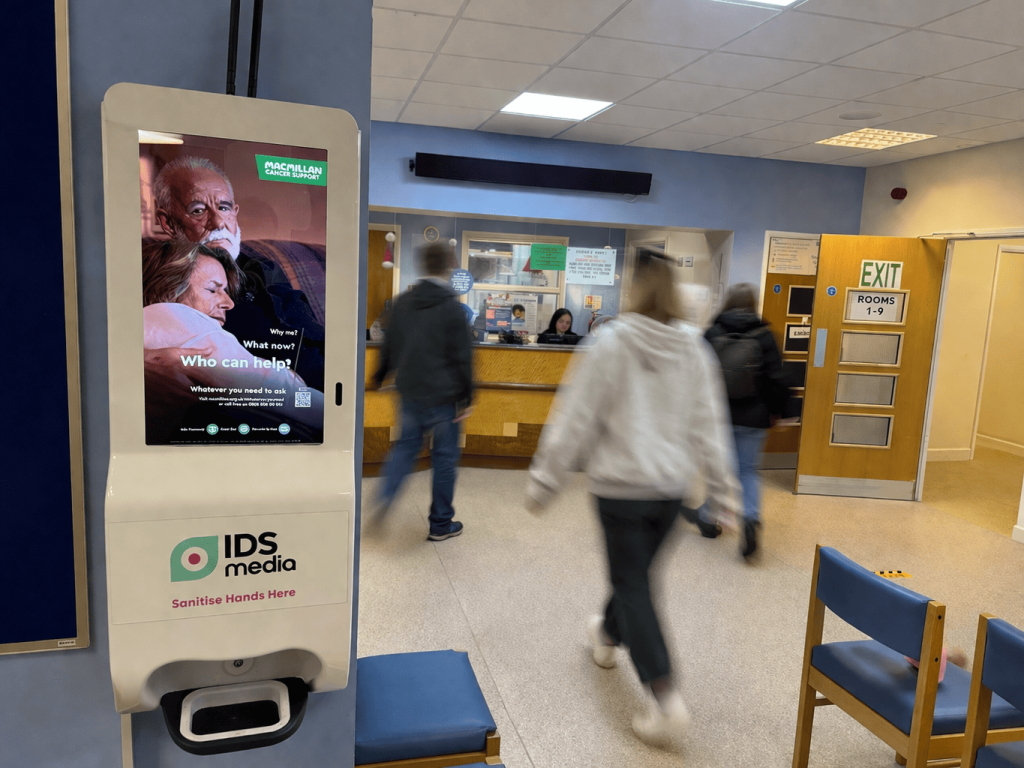
“With our client Macmillan, we don’t just place messaging in one area,” says Dean. “We map out the patient journey – diagnostics, X-ray, oncology – so we’re reaching people at multiple points where that support becomes relevant.”
In antenatal settings, the opportunity becomes even more specific.
“With our advertising for Pampers, we’re talking to expectant parents before they’ve even made their first purchase decision,” he says. “That audience doesn’t really exist anywhere else in the same way.”
The role of companions in decision-making
Another important factor in hospital environments is who is making decisions.
“It’s not always the patient,” explains Dean. “Especially with older audiences, you’ve got family members, carers and people supporting them.”
These companions often:
- Interpret information.
- Reinforce messages.
- Influence next steps.
“They play a huge role,” says Dean. “A lot of the time, they’re the ones helping make decisions.”
This means communication needs to work on more than one level. It needs to speak to:
- The patient.
- And the person supporting them.
Healthcare professionals: where messages turn into action
Hospital environments also introduce another critical audience: healthcare professionals.
“They’ve got automatic respect,” says Dean. “The moment they say something, people listen.”
This creates an important interaction between messaging and conversation.
“The best scenario is when a patient sees something and then mentions it during their appointment,” he explains. “And the healthcare professional already knows about it and reinforces it. That’s gold dust.”
That combination – message plus endorsement – is where behaviour change happens.
The impact can be significant.
In one campaign for The Migraine Trust, the objective was to improve understanding of migraine symptoms among primary care healthcare professionals, while also raising awareness of the charity so patients could be signposted to the right support.
IDS began by surveying clinicians to understand their existing knowledge, confidence levels and awareness of the charity.
The campaign then delivered targeted education packs, including leaflets, letters and posters, directly into primary care settings.
After the campaign, clinicians were surveyed again to measure impact.
The results were clear:
- Around 50% of healthcare professionals initially felt confident diagnosing migraines
- After the campaign, that increased to 70%
“That’s where you start to see real change,” says Dean. “Not just awareness, but actual outcomes.”
Why hospital environments require more precise planning
Hospital environments are more complex than they appear.
“You’re not dealing with one space,” explains Dean. “You’re dealing with lots of different environments within one building.”
Each hospital:
- Has different departments.
- Serves different patient groups.
- Supports different journeys.
“You can’t take a blanket approach,” he says. “You have to understand where people are and what they need at that point.”
That’s why messaging needs to be tailored.
“In a GP setting, you might be encouraging someone to get checked out,” says Dean. “In a hospital, you’re past that point. You’re talking about support, treatment and what happens next.”
Same condition. Different moment. Different message.
When campaigns need to adapt
Even in highly targeted environments, not every campaign lands first time.
One example comes from antenatal environments.
“We initially ran a more commercial Pampers advert,” says Dean. “But it didn’t resonate with midwives – it felt too sales-driven.”
The issue wasn’t the product. It was the tone. So the campaign was adapted.
“We changed the messaging to focus on Pampers donating premature nappies to hospitals,” he explains.
The shift wasn’t just in wording – it changed how the campaign was perceived.
“Instead of it feeling like something was being pushed onto patients, it felt like something that was supporting the hospital environment,” says Dean.
“That made a big difference to how it was received by midwives and staff. It became something they were comfortable having in that space.”
The impact was immediate.
“The resistance disappeared,” he says. “It went from being something that didn’t quite fit, to something that was welcomed.”
And the long-term result speaks for itself.
“It’s been running consistently ever since – completely different response,” says Dean.
In healthcare environments, messaging needs to feel:
- Appropriate.
- Supportive.
- Aligned with the setting.
The biggest misconception about hospital advertising
A common assumption is that patients in hospital environments are too distracted to engage with messaging.
But in practice, that’s not what happens.
“People often assume that because it’s a hospital, people aren’t paying attention,” says Dean. “But actually, they are, especially when something feels relevant to what they’re going through.”
The issue isn’t attention. It’s whether the message fits the moment.
“If it connects to their situation, they’ll notice it,” he explains. “If it doesn’t, they’ll ignore it, same as any other environment.”
“It comes back to understanding where the patient is in their journey,” says Dean. “If you get that right, the engagement follows.”
Why hospital waiting room advertising works
At its best, hospital advertising brings together a combination that’s difficult to replicate elsewhere:
- A health-focused mindset.
- A clearly defined audience.
- Trusted surroundings.
- Immediate relevance.
“The difference is you’re not interrupting,” Dean says. “You’re becoming part of something that’s already happening. And that’s what makes the difference.”
This is what makes hospital environments such a powerful part of the healthcare journey, not just a place where messages are seen, but where they are understood, discussed and acted on.
IDS Media helps organisations deliver targeted, insight-led healthcare campaigns that drive meaningful action.
Get in touch to plan your next campaign.
Source: YouGov research