Seven key takeaways for pharmacy advertising
- Pharmacy advertising is effective because it reaches people at the point of action, when they are ready to make decisions about their health.
- Pharmacies are increasingly a first point of care, with initiatives like Pharmacy First strengthening their role alongside GP services.
- Pharmacies combine retail accessibility with clinical trust, creating a unique environment where messages are both visible and credible.
- Repeat visits reinforce messaging over time, helping build familiarity, understanding and long-term behaviour change.
- Messaging must be clear and immediate, as patients are often task-focused and need to quickly understand what to do next.
- Pharmacists play a key role in influencing understanding and action, reinforcing messages through conversation and advice.
- Pharmacy environments bridge the gap between awareness and action, helping people move from intention to behaviour.
Why pharmacy advertising captures attention differently
Pharmacy advertising works in a different moment of the healthcare journey – not when people are ‘waiting’, but when they’re ‘doing’.
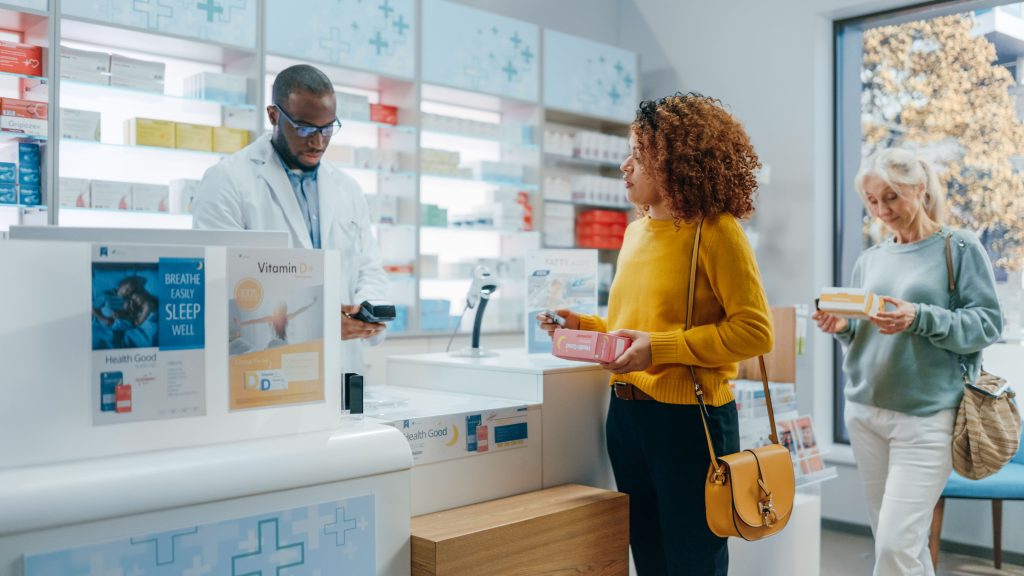
Whether it’s collecting a prescription, asking for advice or picking up treatment, pharmacies are where health decisions start to become action. People are no longer just thinking about symptoms, they’re looking for solutions, reassurance or next steps.
“What’s different in pharmacy is how quickly communication can influence what someone does next,” says Dean Gahagan, Joint Managing Director at IDS Media.
“You’re much closer to the point where a decision is made, whether that’s asking a question, choosing a product or following advice.”
A unique environment: retail space or healthcare setting?
Pharmacies don’t behave like traditional healthcare environments.
They’re open, accessible and often busy, with people browsing, waiting, collecting and asking questions all at the same time. But alongside that, they’re staffed by trained healthcare professionals and trusted as a source of medical advice.
This creates a dual dynamic.
On the one hand:
- A retail environment with movement and choice
While on the other:
- A clinical setting with authority and trust
As Dean puts it: “Pharmacies are almost like mini health hubs now. They still have that retail element, but they’re playing a much bigger role in day-to-day healthcare than they used to.”
For communication, this means campaigns must do two things at once:
- Deliver information that feels credible and useful
- Capture attention quickly
What brings people into pharmacies and why that matters
To understand why pharmacy advertising works, you have to understand why people are there in the first place.
Unlike GP settings, pharmacy visits are rarely passive.
People typically arrive with intent:
- To collect a prescription
- To manage an ongoing condition
- To find relief for symptoms
- To ask a question or seek reassurance
This makes pharmacy behaviour highly contextual.
“Pharmacies are often the next step after a GP or hospital visit – and increasingly, for some conditions, the first point of contact,” says Dean. People come in because they need something – whether that’s medication, advice or reassurance – and they’re ready to act.
“It’s a very different mindset to other environments. You’re not introducing something new; you’re helping someone move forward with something they’re already dealing with.”
That context changes how messaging is received.
Instead of introducing a new idea, effective communication in pharmacies:
- Supports an existing need
- Reinforces previous advice
- Helps people take the next step
Why pharmacy environments work for healthcare communication
Pharmacies are powerful communication spaces because they combine three factors that rarely exist together in one environment:
1. Accessibility
No appointments. High street locations. Regular footfall.
Pharmacies reach people:
- Frequently
- Conveniently
- Across a wide demographic
2. Trust in pharmacists
Pharmacists are highly trusted healthcare professionals, often more accessible than GPs.
They act as:
- A source of reassurance
- A point of clarification
- A bridge between diagnosis and action
As Dean explains: “Pharmacists play a really important role in how people process information. People go there to double check, to ask questions, to make sure they’ve understood what they’ve been told, and they often have more time to do that than in other healthcare settings.
“That combination of accessibility and trust means communication doesn’t just get seen, it gets reinforced through conversation, which is where it really starts to land.”
3. Repeat exposure
Unlike one-off GP visits, pharmacy interactions often happen repeatedly. This creates a powerful advantage:
Messages can be reinforced over time, which is critical for:
- Behaviour change
- Treatment adherence
- Long-term condition management
When pharmacy campaigns need to adapt
Pharmacy environments can be highly effective, but only when messaging aligns with how people actually behave there.
As Dean explains, challenges often arise when campaigns are designed as if people will stop and engage, when in reality, pharmacy visits are often quick, task-focused and driven by immediate need.
“We’ve seen campaigns where the message worked well in other environments, but didn’t translate in pharmacy,” says Dean.
“The issue wasn’t the message itself, it was that it didn’t match how people were behaving in that space.”
In these cases, the problem is often one of timing and clarity.
Patients aren’t browsing in the same way they might in retail, and they’re not sitting with time to reflect like in a GP waiting room. They’re moving through the space with a clear purpose.
What changed?
The adaptation focused on making the message work within that reality:
- Simplifying the core message
- Making the relevance more immediate
- Bringing the benefit forward
- Making the next step obvious
The result
- Stronger engagement with materials
- Improved understanding
- More interaction at the point of care
“Once the message was aligned with what people were actually there to do, it started to land properly,” says Dean. “It’s less about what you’re saying, and more about whether it fits the moment.”
What types of campaigns work best in pharmacies
Campaigns that perform well in pharmacy settings tend to align closely with patient intent. This includes:
Condition and treatment support
- Reinforcing prescriptions
- Supporting ongoing conditions
- Improving adherence
Symptom-led campaigns
- Cold and flu
- Pain relief
- Minor ailments
These work because they match why people are there.
Preventative health campaigns
- Vaccinations
- Smoking cessation
- Lifestyle support
Pharmacies are particularly valuable here because they reach people who may not regularly engage with other healthcare settings.
As Dean explains: “Not everyone goes to the GP regularly, but almost everyone will visit a pharmacy at some point, which makes it one of the most consistent touchpoints in healthcare.”
The role pharmacies play in the wider healthcare journey
Pharmacy advertising doesn’t work in isolation. Its real value comes from how it connects with other healthcare touchpoints.
| GP and hospital environments | Pharmacies |
| Support diagnosis and understanding | Support action, reassurance and continuation of care |
This makes them a critical link in the patient journey. “You’re reinforcing what’s already happened,” says Dean. “Helping people understand it and act on it.”
The growing role of pharmacies in primary care
The role of pharmacies in the healthcare system is evolving rapidly, driven in part by initiatives such as the NHS Pharmacy First programme.
Designed to reduce pressure on GP services, Pharmacy First enables patients to access advice and treatment for a range of common conditions directly through their local pharmacy, without needing a GP appointment.
This shift is changing how patients interact with healthcare.
Pharmacies are no longer just a follow-on step after diagnosis; for many people, they are becoming the first point of contact for care.
As a result, pharmacy environments are playing an increasingly important role in:
- Early intervention
- Symptom management
- Guiding patient decisions at the start of the healthcare journey
This evolution strengthens the connection between GP and pharmacy environments.
While GP settings remain critical for diagnosis and deeper clinical engagement, pharmacies are helping to manage demand, support access and enable faster action at a community level.
For healthcare communication, this creates a more connected pathway.
Campaigns can:
- Build awareness in GP environments
- Reinforce and activate behaviour in pharmacies
- Support patients across the full journey from understanding to action
As healthcare systems continue to adapt, pharmacies are becoming a more integral part of primary care delivery, not just a supporting channel.
Why pharmacies should be part of every healthcare campaign strategy
If GP environments are where attention begins, pharmacies are where behaviour often follows.
They provide:
- Access to large and diverse audiences
- Trusted healthcare interaction
- Opportunities for repeated exposure
- A direct link to action
And crucially, they reach people at the moment when communication can influence what happens next.
This is reinforced by wider healthcare behaviour. YouGov research shows that a majority of patients take action shortly after engaging with health information in a GP setting, highlighting how pharmacy environments can build on that intent and convert it into action.
“It’s where people go to do something about their health, and that’s what makes it so powerful,” says Dean.
Across the IDS Media network alone, pharmacy environments deliver over one million patient interactions each month across more than 600 sites, highlighting the scale and consistency of this touchpoint.
Want to influence patient action at the point of care?
IDS Media helps brands deliver effective campaigns across pharmacy environments, reaching people when they’re ready to take the next step.
Get in touch to plan your next campaign.
Source: YouGov research